Hamadan offers a remarkable combination of archaeological sites, historical monuments, religious landmarks, and natural attractions. From the remains of ancient civilizations to impressive mountain landscapes, the city provides plenty of opportunities to explore Iran’s history and cultural heritage.
Hegmataneh (Ancient Ecbatana), known in ancient Greek sources as Ecbatana, is one of the most significant archaeological sites in western Iran. Inscribed on the UNESCO World Heritage List in 2024, the site contains important and rare evidence of the Median civilization, particularly from the 7th and 6th centuries BCE, as well as archaeological remains from later periods.
Ancient accounts traditionally identify Ecbatana as the capital of the Median Empire. However, although archaeological discoveries confirm the site’s importance during the Median period, its status as the empire’s capital has not been established with certainty. Hegmataneh continued to play an important role in later centuries, serving as a major political center and summer residence for rulers of the Achaemenid, Seleucid, Parthian, and Sasanian periods.
Today, the archaeological remains offer visitors a valuable opportunity to explore the early history of the Iranian Plateau and discover the cultural, political, and architectural legacy of one of ancient Iran’s most remarkable cities.
Ali Sadr Cave, located approximately 75 kilometers northwest of Hamadan, is one of Iran’s most remarkable natural attractions. It is renowned for its extensive underground waterways, vast chambers, and impressive limestone formations.
Visitors can explore parts of the cave by boat, passing beneath spectacular stalactites and stalagmites reflected in the clear underground waters. Its unusual geological features and underground passages make Ali Sadr Cave an unforgettable destination for nature lovers and adventure travelers.
The Ganjnameh Inscriptions, located on the slopes of Mount Alvand near Hamadan, are an important archaeological attraction. The site is best known for its ancient cuneiform inscriptions commissioned by the Achaemenid kings Darius I and Xerxes I.
Written in Old Persian, Elamite, and Babylonian, these inscriptions provide historical information about the Achaemenid rulers and their royal heritage. Surrounded by mountain scenery, waterfalls, and green landscapes, Ganjnameh combines historical exploration with outdoor recreation.
The Avicenna Mausoleum is one of Hamadan’s most recognizable landmarks. It commemorates Abu Ali Sina, widely known in the West as Avicenna, the celebrated Persian physician, philosopher, and scholar whose influence extended far beyond the borders of Iran.
The monument features a distinctive architectural design inspired by traditional Iranian and historical forms. Visitors can also explore the adjoining museum, which displays historical objects, manuscripts, and materials related to Avicenna’s life and intellectual achievements.
The Mausoleum of Baba Taher is dedicated to one of Iran’s beloved classical poets, known for his heartfelt verses and lyrical do-bayti poems. His poetry, traditionally written in a simple and expressive style, has remained popular in Persian literary culture. Located in a pleasant landscaped setting, the mausoleum is an important cultural landmark and a peaceful place for visitors interested in Persian literature and poetry.
The Tomb of Esther and Mordechai is one of Hamadan’s most distinctive religious and historical sites. Traditionally associated with Esther, the Jewish queen of ancient Persia, and her uncle Mordechai, the shrine holds special significance for Jewish communities.
The monument reflects the long-standing Jewish heritage of Hamadan and attracts visitors interested in the religious and cultural history of Iran. Its traditional architecture and historical associations make it a notable landmark within the city.
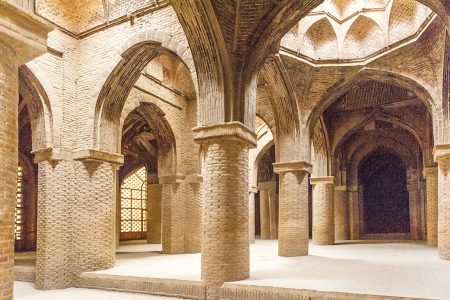
The Jameh Mosque of Hamadan, located in the historic center of Hamadan, is an important example of Islamic religious architecture in the city. Its traditional architectural elements, decorative details, and spacious courtyard reflect the region’s religious and cultural traditions.
The mosque remains an important place of worship and provides visitors with an opportunity to appreciate the architectural heritage of Hamadan.
Gonbad-e Alavian is one of Hamadan’s most remarkable historical monuments, known for its intricate decorative brickwork and elaborate stucco ornamentation. Dating back to the medieval period, the structure is particularly admired for the craftsmanship of its interior and exterior details.
Its architectural features make it an important example of the artistic and religious traditions that developed in western Iran.
Shir-e Sangi, meaning the Stone Lion, is an ancient carved monument located in Hamadan. This distinctive sculpture has become one of the city’s recognizable historical symbols.
The origins and original purpose of the stone lion have been discussed by historians, but its presence reflects the long history of the city and the artistic traditions of earlier periods.
Lalejin: A Center of Persian Pottery. Located north of Hamadan, Lalejin is widely known for its pottery and ceramic craftsmanship. The town has a long tradition of producing handmade pottery, decorative ceramics, and functional household objects.
Visitors can explore local workshops, observe traditional pottery-making techniques, and discover the artistic skills passed down through generations. Lalejin offers a valuable opportunity to experience the living craft traditions of western Iran and makes an excellent excursion from Hamadan.