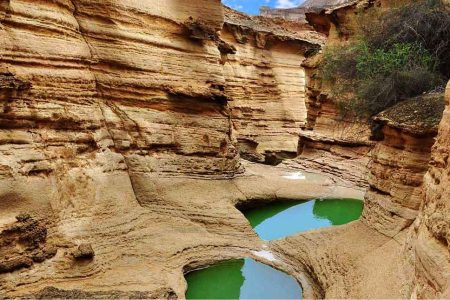
The Rigareh Underground Watermill, located in the historic Mohammadieh neighbourhood near Nain, the Rigareh Underground Watermill is a remarkable example of traditional engineering adapted to desert conditions. Built deep underground and powered by water from the Keykhosrow qanat, the mill demonstrates how local communities made effective use of limited water resources. Its underground passages and ingenious mechanism offer visitors a fascinating insight into the ingenuity of life in Iran’s central desert.
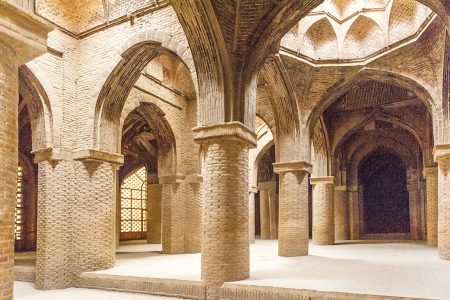
The Jameh Mosque of Nain is one of Iran’s oldest surviving mosques, with its earliest structure dating back to the early Islamic period. Developed and expanded over several centuries, the mosque is notable for its distinctive architectural layout, finely detailed stucco decoration, and elegant brickwork. Its richly ornamented mihrab, historic prayer halls, and approximately 28-metre-high octagonal minaret are among its most remarkable features. Unlike many later Iranian mosques, it does not follow the familiar four-iwan plan, making it an important example of early Islamic architecture in central Iran.
Fatemi House, located in the historic Noghabad neighbourhood near Nain’s old bazaar, is one of the city’s finest examples of traditional residential architecture. Built during the Qajar period, with origins possibly dating to the late Zand era, the mansion once belonged to the influential Fatemi family. Its spacious layout includes several courtyards and distinct private and public sections, reflecting the structure of traditional Iranian family homes.
The house is particularly admired for its decorative details, including intricate plasterwork, carved wooden doors, and elegant orosi windows fitted with colourful stained glass. These features, together with its carefully arranged courtyards and living spaces, offer a glimpse into the domestic architecture and lifestyle of affluent families in Iran’s central desert region.
Narin Castle, located in the heart of Nain’s historic district, Narin Castle, also known as Narenj Castle, is among the oldest surviving structures in the city. Its origins are generally attributed to the Parthian period, although the site appears to have been used and modified over several centuries. Built mainly of sun-dried mud bricks, the fortress once featured defensive towers and a surrounding moat, forming part of the historic settlement around which the city developed.
Today, only sections of its original walls and structures remain, but the ruins still offer a glimpse into Nain’s early urban history and traditional defensive architecture. The castle is an important landmark for understanding the city’s development and its long-standing role as a settlement in Iran’s central desert region.
Pirnia House and Kavir Anthropology Museum, located opposite the Jameh Mosque of Nain, Pirnia House is a remarkable example of Safavid-era residential architecture adapted to the region’s desert climate. Originally built as the residence of the local governor, the house later became the property of the Pirnia family during the Qajar period. Its traditional layout includes a central sunken courtyard, private and public living spaces, and carefully designed rooms that helped maintain comfort in the hot, dry environment.
The house is particularly admired for its intricate stucco reliefs, decorative wall paintings, and traditional architectural details. Today, it houses the Kavir Anthropology Museum, where visitors can discover the customs, clothing, tools, crafts, and everyday life of communities from Iran’s desert regions. Exhibits on traditional weaving, agriculture, and water management provide a deeper understanding of how people adapted to life in the central Iranian plateau.
Nain’s Old Bazaar is one of the historic landmarks that reflects the city’s traditional commercial and urban life. Extending through the old town, this covered market once served as an important centre of trade and connected several historic neighbourhoods. Its traditional brick vaults, domed ceilings, and small circular skylights create an architectural character well suited to the region’s hot, dry climate.
Along its winding passageways, visitors can discover the remains of traditional shops, historic crossroads known as chahar-su, and nearby religious and community spaces. Although much of the city’s commercial activity has moved to newer areas, the old bazaar remains an important part of Nain’s architectural heritage and offers a glimpse into the everyday life of its historic community.
The Mosallah Edifice and Garden is one of Nain’s notable historic complexes, combining a traditional Persian garden with a distinctive mausoleum and water structures. The garden is enclosed by high brick walls, while an elegant octagonal mausoleum with a turquoise dome stands at its centre. The complex reflects the architectural traditions of the Qajar period and is closely associated with the history of several prominent local figures.
One of its most interesting features is a historic water reservoir, or ab-anbar, equipped with two windcatchers that helped keep the stored water cool during the hot summer months. Together, the garden, mausoleum, and traditional water system offer an insight into the architectural heritage and practical ingenuity of life in Nain’s desert environment.